



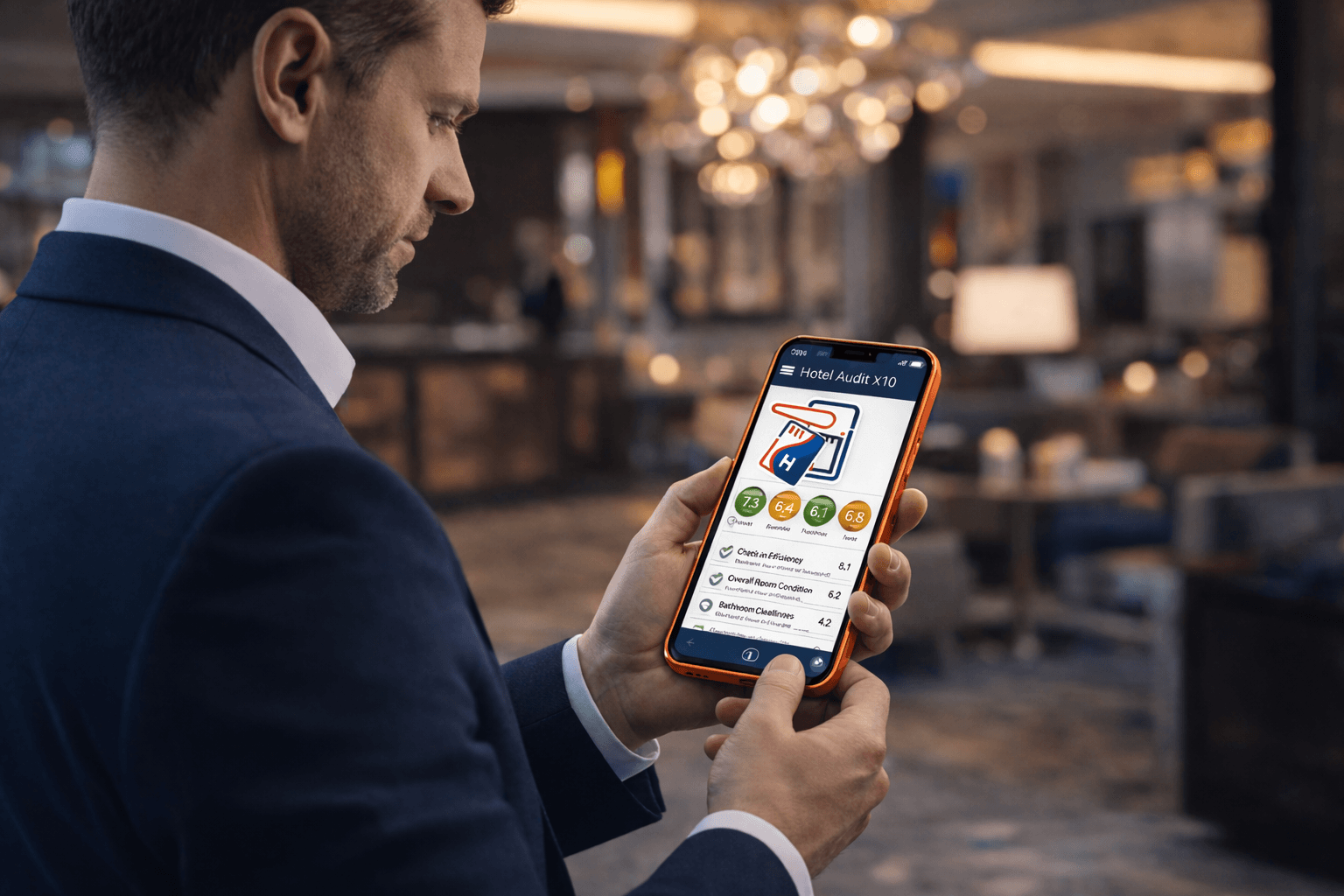
In traditional hotel audits, the biggest challenge has never been a lack of data. Hotels today are flooded with photographs, guest comments, Excel spreadsheets, emails, OTA reviews, internal SOPs, and reports from multiple systems. The real issue is time — and the ability to turn all that data into clear, actionable decisions. In practice, it is rare to receive a single coherent report that clearly states what is critical, what directly impacts revenue, what can be fixed quickly, and where reputation and profit are leaking.
Hotel Audit X10 Experience was developed precisely for this reason. Not as just another audit tool, but as an audit engine. Within this system, AI and LLM models are not add-ons or “tech decoration” — they are core components that accelerate data processing, standardize scoring, and elevate report quality to a level that, until recently, was achievable only by large hotel groups with internal QA and corporate audit teams.
What AI and LLMs Do in Practice — On the Ground
During a real hotel audit, a large volume of so-called “non-sterile” input is generated. Short auditor notes, photographs, scores, staff comments, competitive comparisons, and subjective impressions are notoriously difficult to structure later into a high-quality report.
Within Hotel Audit X10 Experience, AI and LLM models transform this data into clear, structured findings. Unstructured notes are automatically converted into a standardized format that includes the finding itself, its impact, the recommendation, the responsible owner, and a timeline. At the same time, the system tags each finding according to the guest experience zone — such as arrival, room readiness, F&B, cleanliness, booking UX, upselling, or brand compliance.
Equally important, AI performs deduplication. Instead of repeating five similar comments across different sections of the report, the system consolidates them into one strong, weighted finding.
In practical terms, this means that an audit with more than 250 checkpoints — which would normally require six to ten hours of manual writing for the textual report alone — can be completed in two to four hours with LLM assistance. This represents a time saving of 40 to 70 percent, while delivering a far more consistent structure and significantly fewer gaps in the final report.
Image Processing — When Photos Become Evidence, Not Attachments
Photographs are one of the most important elements of a hotel audit, yet in traditional PDF reports they are often lost, disconnected from context and findings.
In Hotel Audit X10 Experience, AI treats images as an active part of the analysis. The system identifies recurring issues such as stains, damage, poor detailing, clutter, brand standard inconsistencies, inadequate signage, lighting problems, or issues with linens and towels. Each photo is automatically linked to the relevant checkpoint — for example, “Bathroom details – 6/10” — turning it into evidence rather than mere illustration.
AI also detects patterns. If the same type of issue appears across 15 or 20 photos in different rooms or areas of the hotel, it is clearly flagged as a systemic problem rather than an isolated incident.
A typical auditor captures between 150 and 400 photos per audit, depending on the size of the property. Manually sorting and describing these images can take between 90 and 180 minutes. With AI tagging and automated pre-descriptions, this process is reduced to 25 to 60 minutes — a time saving of 60 to 80 percent.
Calculations and Scoring — Faster and Without Excel Chaos
One of the biggest time killers in traditional audits is combining individual scores into a meaningful overall picture. Excel spreadsheets, formulas, weightings, and manual checks often take longer than the on-site audit itself.
AI and LLMs within Hotel Audit X10 automatically calculate weighted scores across all zones. Arrival, rooms, cleanliness, F&B, digital channels, and loyalty each have predefined weightings that adapt to the hotel’s profile. The system also adds a confidence indicator, clearly showing where scores are supported by evidence such as photos, repeated findings, or staff comments.
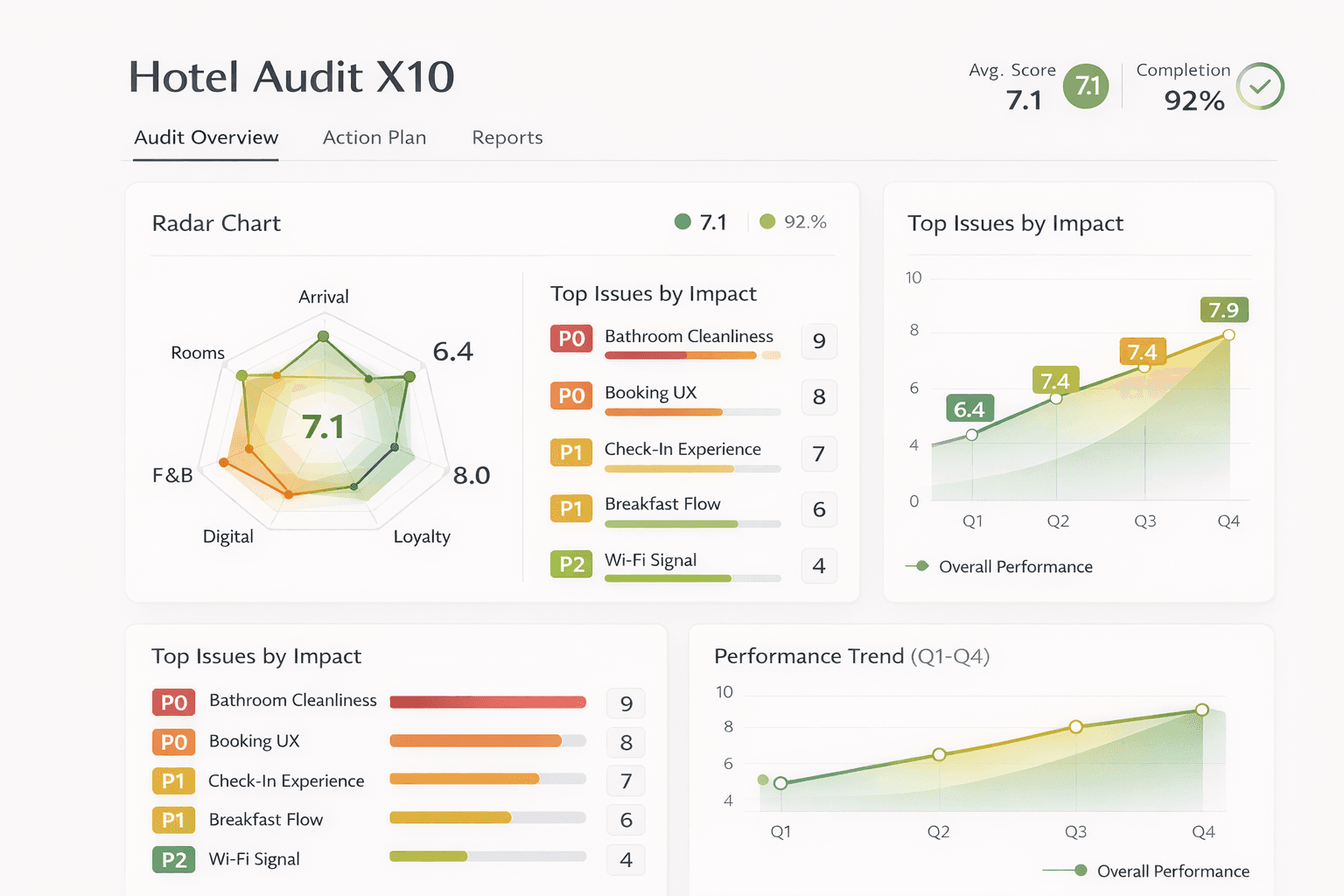
In addition, AI detects anomalies. For example, if “Room cleanliness” is scored 9 out of 10 but is contradicted by twelve photographic proofs, the system flags the inconsistency and requests further validation.
In practice, manual score matrix construction takes 60 to 120 minutes. Automated scoring with Hotel Audit X10 takes five to fifteen minutes, followed by a final professional review by the auditor.
How Hotels Receive Better Reports — Less “Pretty PDF,” More Action Tool
The key difference introduced by an AI-driven audit is report quality. LLM models transform the audit into a document that management actually reads and uses.
The executive section is short and focused, typically one to two pages. The operational section is concrete, structured by department, and action-oriented. Priorities are clearly marked as P0, P1, and P2, with no grey areas.
A typical report structure includes an executive summary with ten key findings and the three largest revenue leaks, a heatmap by hotel zones highlighting risk areas, a detailed action plan with owners, deadlines, estimated costs, and expected impact, and photo evidence grouped by theme rather than presented as an unstructured gallery.
Charts and Diagrams Management Uses in Meetings
Instead of context-free tables, the report provides a visual layer suitable for operational and board-level discussions. Radar charts display scores from 1 to 10 across zones, such as Arrival 7.8, Rooms 6.4, Cleanliness 7.1, F&B 8.0, Digital 5.9, and Loyalty 6.2.
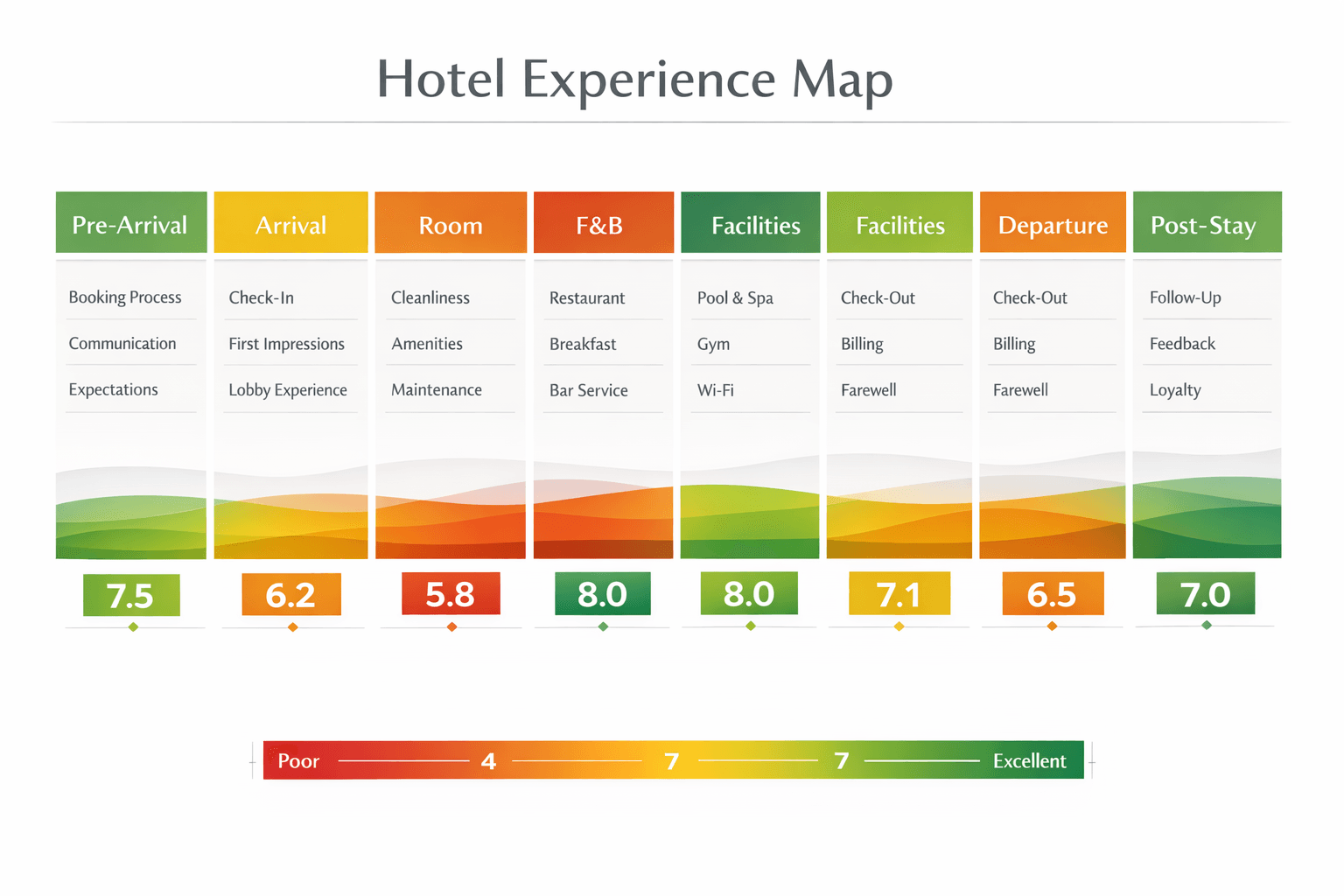
Pareto analysis clearly shows that 20 percent of causes generate 80 percent of negative perception — such as bathroom details, check-in friction, weak booking UX, or inefficient breakfast flow. Heatmaps by floor or room type reveal quality gaps, for example standard rooms scoring 6.1 compared to suites at 7.4. In quarterly audits, trend lines illustrate progress, such as overall scores rising from 6.2 to 7.4 while the digital segment stagnates.
Scoring Management Understands — 1 to 10, with Logic
Hotel Audit X10 uses a 1-to-10 scoring scale because it is intuitive, but each score is backed by clear interpretation. Scores of 9 and 10 indicate premium performance with no friction and standards exceeding expectations. Scores of 7 and 8 represent a solid system with “silent leaks” already visible in reviews and conversion metrics. Scores of 5 and 6 reflect average performance that guests notice and that increases OTA dependency. Anything below 5 signals reputational risk and the need for immediate corrective action.
Within the report, this is presented through clear tables linking each zone to its score, rationale, and priority — removing subjectivity and enabling concrete decisions.
How Much AI Actually Accelerates Audits — Numbers Hotels Feel
For a mid-sized hotel with 80 to 150 rooms, a traditional audit including on-site work and reporting takes between 17 and 27 hours. With Hotel Audit X10 Experience and AI, the same audit takes 10 to 16 hours. This translates into 30 to 45 percent less total time, while delivering two to three times more usable output in the form of charts, action plans, and standardized insights. The greatest advantage is faster time-to-action: hotels receive their P0 issue list immediately, not days later when the PDF is finalized.
AI Does Not Replace the Auditor — But It Changes the Game
AI cannot replace brand context, the distinction between boutique, resort, and business hotels, the guest’s emotional perception and service micro-rituals, or strategic prioritization through P&L.
What it does is fundamentally change the auditor’s workflow.
Less typing.
Less sorting.
More observing.
More reasoning.
More strategic impact.
That is why, in Hotel Audit X10, AI acts as a co-pilot — while the auditor remains firmly in the pilot’s seat.


Rafik
Need some info
Dean Matic
you can contact us at our e-mail [email protected]