



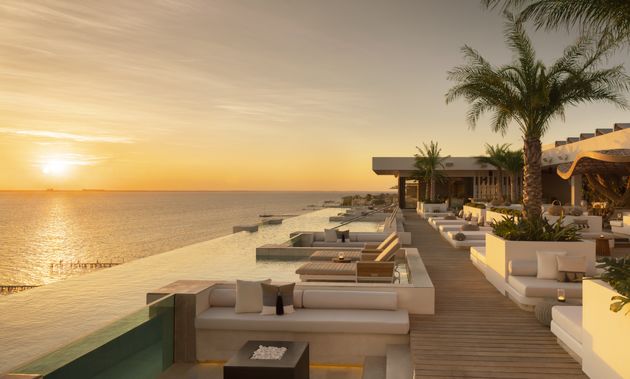
Adults Only hotels today are no longer a trend or a marketing label. They are a direct response to a clearly defined demand from guests who travel without children and expect peace, privacy, spatial control, and an emotionally aligned experience. Globally, it is estimated that there are currently between 900 and 1,100 hotels and resorts explicitly positioned as Adults Only, with this number having increased by more than 70 percent over the past ten years. This is precisely why this segment of the hospitality industry carries some of the highest expectations and simultaneously one of the lowest tolerances for mistakes. Guests of Adults Only hotels do not arrive for compromises; they arrive for a feeling.
In practice, it is often overlooked that the same term, Adults Only, represents two fundamentally different products in Europe and in the UAE. Although formally the category is the same, the differences in culture, market dynamics, and guest psychology are so pronounced that a standard hotel audit quickly becomes imprecise, superficial, or even misleading. This becomes particularly evident when considering that more than 60 percent of all Adults Only hotels globally are located in Europe, while the UAE market is numerically much smaller but financially far stronger. This is exactly where the need arises for a deeper, more nuanced approach, such as the one applied by Hotel Audit X10.
In the European context, an Adults Only hotel most often functions as a space of escape. Guests arrive to disconnect from everyday life, family obligations, and an accelerated lifestyle. The highest concentration of such hotels can be found in Spain, Greece, Italy, and across Mediterranean islands, where Adults Only hotels are estimated to account for between 8 and 12 percent of the total hotel supply within the premium leisure segment. These properties are frequently located in natural surroundings, along the coast, in smaller destinations, or within boutique concepts where the emphasis lies on atmosphere, silence, and a personal relationship with the hotel. Lengths of stay are longer, averaging five to seven nights, and the experience is built slowly through details, daily rhythm, and a sense of belonging to the space. In this environment, an audit cannot measure only technical process compliance; it must understand the emotional dimension of space, design subtlety, levels of quietness, and the way in which the guest is allowed to slow down.
In the UAE, an Adults Only hotel serves an entirely different purpose. It is not an escape, but a sophisticated lifestyle product. Although Dubai today counts more than 800 hotels and over 150,000 rooms, the number of fully Adults Only hotels remains relatively small, estimated at between 20 and 30 properties, including pure Adults Only hotels and luxury resorts with clearly separated adult-only zones. Guests arrive for privacy, discretion, and perfectly controlled luxury. Stays are shorter, averaging two to four nights, but expectations per night are significantly higher, with ADR levels often 30 to 50 percent higher than comparable upscale hotels in Europe. Every element must operate with precision without improvisation, without waiting times, and without visible operational weaknesses. Luxury in the UAE is not defined solely by aesthetics, but by the assurance that the experience will be flawlessly delivered from the first to the final moment. In this context, an audit must measure levels of control, consistency, and operational discipline, because every mistake directly impacts reputation and revenue.
The differences are already evident in architecture and design. In Europe, Adults Only hotels often feature smaller room sizes but a strong sense of character. Average room sizes in this segment are frequently 10 to 20 percent smaller than in conventional leisure hotels, yet design is focused on creating intimacy, connection with the environment, and the feeling of a private retreat. Materials, lighting, and acoustics play a decisive role in shaping the atmosphere. In the UAE, design must be impressive while simultaneously functional in protecting privacy. Larger suites, private pools, and physical separation become standard, with more than 40 percent of Adults Only offerings in the UAE including private outdoor spaces. In such properties, Hotel Audit X10 does not assess aesthetics alone, but also the level of visual and acoustic isolation and the guest’s perception of spatial control.
Spa and wellness facilities further emphasize the contrast between the two markets. In Europe, the spa is an emotional ritual an extension of the hotel’s philosophy and often deeply connected to nature and local identity. More than 65 percent of European Adults Only hotels position wellness as the primary reason for guest arrival. Silence, slowness, and a sense of relaxation carry more weight than formality. Overly rigid spa structures in European Adults Only hotels often diminish the experience. In the UAE, spa is a luxury discipline. Every step is predefined, every appointment precisely managed, and guest privacy is absolute. Waiting times, unclear flow, or staff improvisation are not tolerated, as the spa experience is perceived as part of the hotel’s premium performance.
The same contrast is visible in gastronomy. In Europe, Adults Only guests seek rhythm, atmosphere, and intimacy. Restaurants form part of the hotel’s identity, and dining is an experience not measured in minutes. In the UAE, gastronomy is a highly professionalized luxury segment, often driven by international chef concepts and exceptionally high presentation standards. Reaction time, service precision, and consistency become measurable KPIs, as even a difference of a few minutes in service delivery can directly influence online reviews and ratings in the UAE luxury segment.
The role of staff further separates these two worlds. In Europe, warmth, informality, and a sense of hosting are valued. Mistakes may be tolerated if the relationship feels genuine and human. In the UAE, staff are expected to be discreet, precise, and professionally distant. Here, luxury means reliability and control, not emotional closeness. Hotel Audit X10 therefore applies different models for evaluating communication and staff behavior depending on the market, as the same interaction does not carry the same value in Dubrovnik as it does in Dubai.
The digital guest journey in Adults Only hotels also differs significantly. In Europe, the emphasis lies on simplicity, content, and storytelling that attracts the guest. Digital sophistication may be moderate if the on-site experience is strong. In the UAE, digital control of the stay begins before arrival and continues through departure. Personalization, WhatsApp concierge services, and flawless communication become standard, and any digital inconsistency directly affects the perception of luxury and online ratings.
All these differences lead to the same conclusion: an Adults Only hotel cannot be audited using a universal model. Hotels most often fail when attempting to replicate the European approach in the UAE, or vice versa, without understanding local guest psychology. The result is properties that are operationally correct but emotionally misaligned.
Hotel Audit X10 therefore treats Adults Only hotels as a distinct ecosystem. It does not analyze only what a hotel has, but how the guest experiences every moment of the stay—and how that experience translates into reputation, loyalty, and revenue. In this segment, luxury is not defined by star ratings, but by precisely aligned emotions and operations.
Adults Only is not a format.
It is a promise—and an audit must be able to measure how well that promise is truly delivered.