



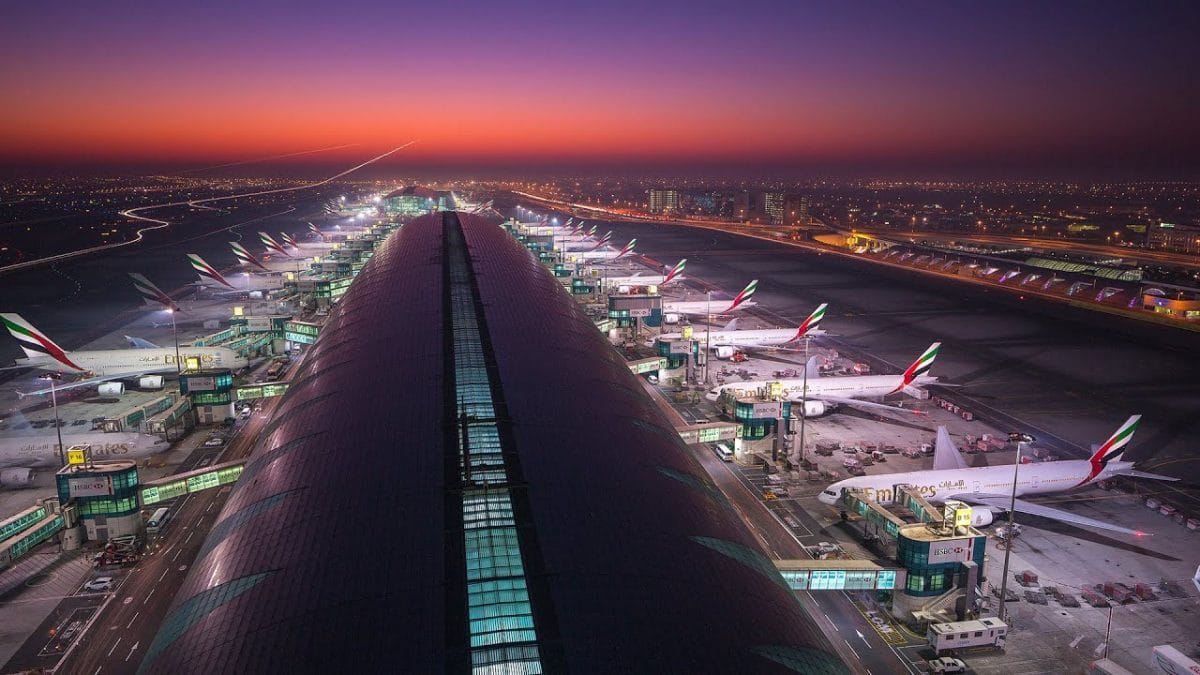
Dubai is not just a global aviation hub. Dubai is one of the largest daily rest bases for airline crews in the world. From the perspective of Hotel Audit X10, this is a market with its own logic, its own KPIs, and rules that have very little in common with classic hospitality storytelling.
Every single day, more than 1,300 commercial flights move through Dubai International Airport and Al Maktoum International Airport. Emirates alone operates a fleet of roughly 260 wide-body aircraft, while flydubai adds around 85 aircraft into the daily operational mix. When other international airlines using Dubai as a layover or crew rest base are included, the number reaches between 8,000 and 12,000 crew members per day who temporarily call Dubai their home between flights.
These are not tourists. They are not classic business travellers. They are an operational population.
That is precisely why business hotels designed for flight and cabin crews in Dubai operate under a completely different set of rules compared to standard business hotels.
Hotel Audit X10 does not ask how impressive the hotel looks. It asks whether the hotel functions as a direct extension of flight operations, or merely as generic accommodation.
The difference is fundamental.
Pilots and cabin crew do not rest in the same way, do not follow the same rhythm, and do not share identical expectations. A pilot typically benefits from a longer minimum rest period, often between 12 and 24 hours, with a strict focus on deep sleep, silence, and controlled environmental conditions. The room must be acoustically insulated, temperature-stable, fully blacked out, and free of unnecessary stimuli. A pilot is not looking for experiences. A pilot is looking for a physiological reset, knowing that the next duty cycle involves responsibility for hundreds of passengers.
Cabin crew, on the other hand, often operates with shorter rest windows, frequently between 10 and 14 hours, combined with different physical and mental fatigue. Alongside quality sleep, their expectations include immediate access to food, fast logistics, personal safety, and absolute predictability. They arrive at hotels exhausted, often late at night or in the early morning hours, with zero tolerance for waiting, confusion, or improvisation.
This is where Hotel Audit X10 draws a critical distinction. It maps different rest profiles within the same crew operation and evaluates whether the hotel even recognises that these differences exist.
In reality, audits in Dubai frequently reveal a paradox. Hotels look impressive, but they are not built for silence. Glass façades, atriums, nightlife, and architectural spectacle often conflict directly with crew recovery needs. A room that is perfect for a leisure guest can be entirely unsuitable for a pilot arriving at 03:40 and needing uninterrupted sleep until late morning.
The challenge becomes even more visible in food and beverage operations. Crews do not eat when the hotel wants them to. They eat when flight schedules allow it. Hotel Audit X10 therefore does not ask whether a restaurant exists, but whether nutritionally adequate meals are accessible, fast, and consistent at any hour of the day or night. In this segment, food is not an experience. It is fuel.
Logistics form the third critical pillar. Transfers between hotel and airport must be precise and repeatable. A five-minute deviation in Dubai can trigger flight delays, crew rotation issues, and operational incidents invisible to passengers but clearly visible in airline reports. Hotel Audit X10 measures real transfer times, back-up scenarios, and system resilience, not promises written on a website.
The numbers explain why this segment matters. Crew accommodation contracts in Dubai are estimated to generate over EUR 1.2 billion in annual hotel revenue, characterised by high stability and low marketing costs. But it is also a zero-tolerance market. One failed audit, repeated crew complaints, or declining SLA metrics can be enough for an airline to move its crews elsewhere.
In this environment, Hotel Audit X10 is not a reporting exercise. It is a contract-retention tool.
The key difference between an average and a top-tier crew hotel in Dubai is not price or star rating. It is the understanding that the hotel is part of the aviation ecosystem, not just hospitality. Once a hotel understands that, it stops asking how the lobby looks and starts asking how quietly, quickly, and reliably the system performs at 04:00 in the morning.
And it is precisely there, in the silence of hotel corridors while the city is still asleep, that Hotel Audit X10 sees what other audits miss – whether the hotel truly works for the crew, or merely appears to do so.