



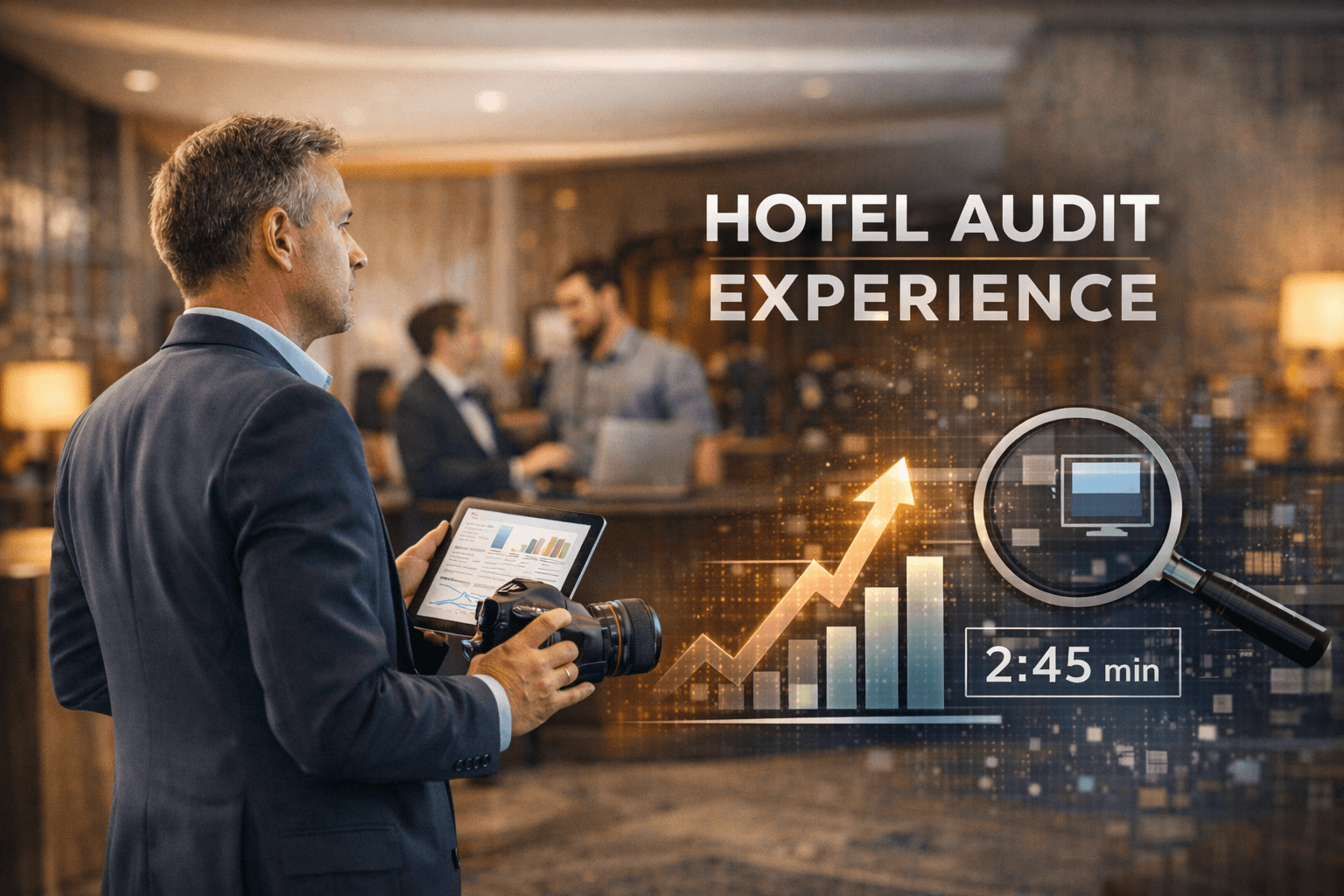
In the age of artificial intelligence, hotel auditing has never been more precise, faster, or analytically deeper. AI engines such as the Hotel Audit X10 Experience application can now process 1500+ structured checkpoints, benchmark a hotel against dozens of reference models, and clearly identify where systems are not functioning optimally – all within just a few minutes. Yet despite this technological power, the auditor remains the key figure in the entire process. Not as a passive observer of data, but as someone who truly understands the hotel from the inside.
An experienced auditor is not someone who knows a hotel only through spreadsheets. It is a professional who has been in over 100 hotels, across different countries, markets, and categories. Someone who understands what a real check-in looks like between 18:00 and 19:00, when a queue forms at reception within 90-120 seconds. Someone who has spoken with guests in elevators, restaurants, and by the pool – often in spontaneous interactions lasting 20-60 seconds, yet revealing more than ten surveys combined. Someone who understands the gap between what is written in procedures and what actually happens in daily operations.
This is where what we call voyeur context comes into play – the auditor’s ability to see the hotel exactly as the guest sees it, but with professional experience and analytical distance. The auditor observes front-desk behaviour, non-verbal communication, response speed (often measured in seconds, not minutes), tone of voice, delays, improvisations, and small operational “shortcuts” that occur in everyday work. These are details AI cannot independently detect because they do not exist in traditional datasets, yet they directly influence guest experience and brand perception.
AI engines excel at recognising patterns – conversion drops, illogical flows, weak touchpoints within the guest journey. In practice, this means that in real time, often within 30-90 seconds, the system connects data from the website, booking flow, and content layers. However, AI does not understand context. It does not know whether a hotel is a resort or a city break property, whether it is operating in peak or shoulder season, or whether the team is newly formed or highly experienced. The auditor takes AI findings and places them within the hotel’s real operational and market framework.
While AI clearly shows what is not optimal, the auditor decides what is critical. The auditor distinguishes between issues that are merely aesthetic and those that directly result in lost revenue. They assess where the fastest return on investment lies – often measurable in weeks or months, not years. An experienced auditor knows what can be resolved through 30 minutes of training and what requires a multi-phase process change. This is how an audit stops being a list of findings and becomes a concrete decision-making roadmap.
Equally important, the auditor is the one who takes responsibility. Hotel management does not seek another automated report – it seeks a clear position. The auditor stands behind the recommendations, explains them to the GM, owner, or board, and adapts them to realistic budgets and team capacities. Through the Hotel Audit X10 Experience application, section-based reports (front office, rooms, F&B, digital guest journey) are generated in real time, often within 2-5 minutes per section, but it is the auditor who transforms these insights into decisions.
The unique value of the auditor lies in combining hard data with soft experience. AI excels in metrics, analytics, and benchmarking. The auditor understands guest emotion, the first impression formed within the first 7-15 seconds of entering a hotel, the psychology of trust, uncertainty, and the reasons why guests feel comfortable in one hotel but not in another. It is precisely within these nuances that the difference between an average and an exceptional hotel is created.
The Hotel Audit X10 Experience application delivers standardisation, measurability, and objectivity. During the audit, the auditor uses AI-assisted photography, where visual material is captured in seconds, automatically analysed, and linked to exact checkpoints and locations. In practice, this means that visual evidence and analysis are generated simultaneously, without additional administrative workload. Yet the auditor personalises the audit. They remove the one-size-fits-all logic and convert standard scoring into a tailored development roadmap aligned with the hotel’s identity and ambitions.
Ultimately, an audit is not a final document. It is the beginning of change. AI can generate analysis in minutes, but the auditor leads the hotel through transformation – explaining findings to teams, communicating with front office, operations, and management, and monitoring implementation over time, often through follow-up cycles defined in weeks and months.
Hotel Audit X10 Experience is built on a simple but powerful logic:
- AI engines and auditors together deliver decisions that are 10x better than either alone.
- AI delivers speed, scale, and objectivity measurable in seconds and minutes.
- The auditor delivers experience, context, voyeur insight, and accountability measured in results.
Only through this synergy does an audit become a tool that changes outcomes – not just a report.